9 June
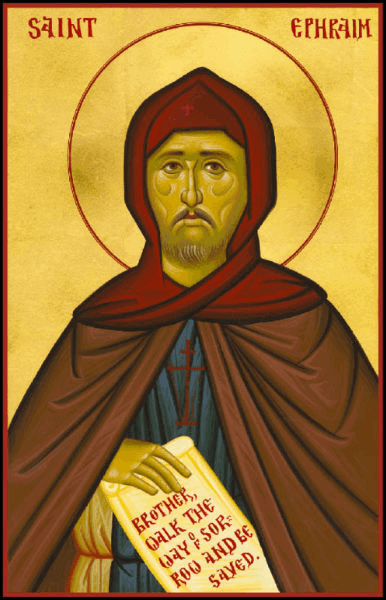
St Ephrem (c. 306-373)
Deacon and Doctor
Born c. 306, Nisibis (modern-day Nusaybin, Turkey)
Died 9 June 373, Edessa (modern-day Şanlıurfa, Turkey)
Venerated in Catholic Church, Eastern Orthodox Church, Church of the East Oriental, Orthodox Churches, Anglican Communion
Patron Spiritual directors; spiritual leaders
St. Ephrem, Deacon, called “the Harp of the Holy Spirit,” is the great classic Doctor of the Syrian church. As deacon at Edessa, he vigorously combated the heresies of his time, and to do so more effectively wrote poems and hymns about the mysteries of Christ, the Blessed Virgin and the saints. He had a great devotion to Our Lady. He was a commentator on Scripture and a preacher as well as a poet, and has left a considerable number of works, which were translated into other Eastern languages as well as into Greek and Latin. He died in 373. Benedict XV proclaimed him a Doctor of the Church in 1920.
COLLECT PRAYER
Pour into our hearts O Lord, we pray, the Holy Spirit, at whose prompting the Deacon Saint Ephrem exulted in singing of your mysteries and from whom he received the strength to serve you alone. Through our Lord Jesus Christ, your Son, who lives and reigns with you in the unity of the Holy Spirit, God, for ever and ever.
Things to Do:
- Learn more about St. Ephrem here.
- Read some of the writings of St. Ephrem.
- Read Pope Benedict XV’s Encyclical Principi Apostolorum Petro on St. Ephrem.
St. Ephrem
Ephrem was of Syrian descent and son of a citizen of Nisibis. While yet a young man be betook himself to the holy bishop James, by whom he was baptized, and he soon made such progress in holiness and learning as to be appointed master in the school of Nisibis in Mesopotamia. After the death of the bishop James, Nisibis was captured by the Persians, and Ephrem went to Edessa, where he settled first among the monks in the mountains. Later, to avoid the company of those who flocked to him, he adopted the eremitical life. He was made deacon of the church of Edessa, but refused the priesthood out of humility. He was rich in all virtues and strove to acquire piety and religion by the following of true wisdom. He placed all his hope in God, despised all human and transitory things, and was ever filled with the earnest desire of those which are divine and eternal.
He was led by the Spirit of God to Caesarea in Cappadocia, where he saw Basil, the mouthpiece of the Church, and they obtained benefit from their mutual intercourse. In order to refute the many errors which troubled the Church at that time, and to expound the mysteries of Jesus Christ, he wrote many books in the Syrian tongue, almost all of which have been translated into Greek. St. Jerome bears witness that he attained such fame that his writings were read publicly in the churches after the reading from the Holy Scriptures.
On account of his works, so full of the light of heavenly doctrine, he was greatly honored even during his lifetime as a Doctor of the Church. He composed a poem in praise of the Blessed Virgin Mary and the saints for which he was called by the Syrians “the Harp of the Holy Ghost.” He was noted for his great and tender devotion towards the immaculate Virgin. He died, rich in merits, at Edessa in Mesopotamia, on the fourteenth of the Kalends of July, in the reign of Valens. Pope Benedict XV, at the instance of many Cardinals of the Holy Roman Church, patriarchs, archbishops, bishops, abbots and religious communities, declared him by a decree of the Sacred Congregation of Rites to be a Doctor of the Universal Church.
—Excerpted from The Liturgical Year, Abbot Gueranger O.S.B.
Source: Catholic Culture